
What does a traditional product dispensing system really cost?
Traditional product dispensing costs more than material invoices alone suggest: two people’s time for every issue, production delays, uncontrolled consumption, excess inventory and missing data. This article explains how to identify and calculate these costs in your own facility.
The question “how much does it cost?” is often raised only when high operating costs are already visible in the company’s financial results.
This guide is written primarily for people responsible for a company’s financial performance. A chief financial officer or an equivalent decision-maker may need to justify changes to supply, warehousing and logistics processes. Their responsibilities include cost optimisation and protecting the profitability of the business.
Other stakeholders also have an interest in controlling these costs, including company directors, plant managers, production managers and procurement teams.
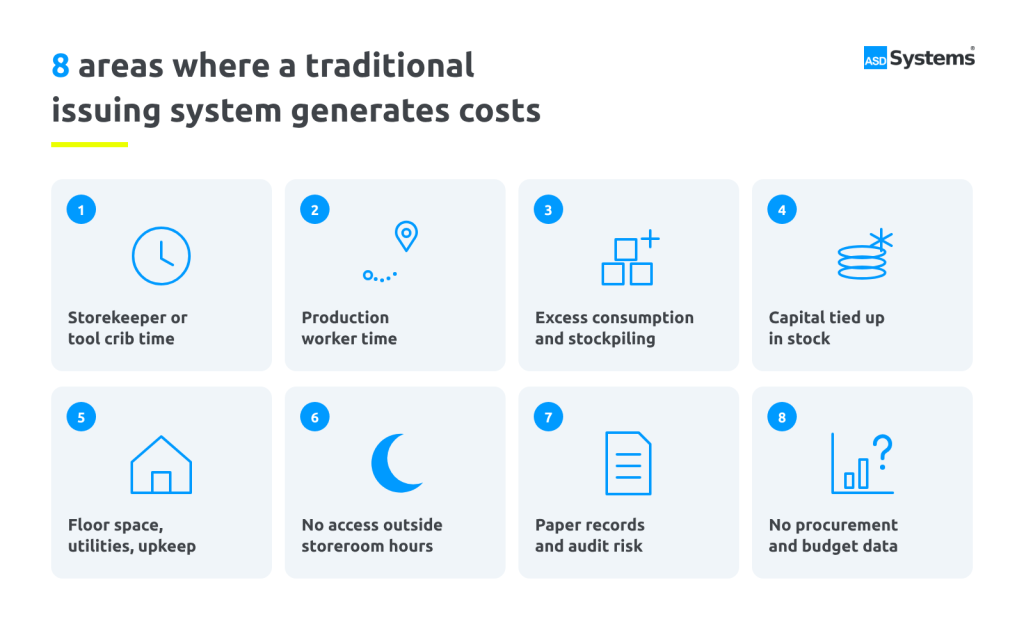
This article does not provide a single savings figure for replacing an existing storage and dispensing system. Instead, it identifies eight areas in which traditional product dispensing can generate significant costs and provides a checklist to help you assess their scale in your own facility.
Why does this article not provide a single figure?
The cost of traditional product dispensing depends on many factors: the number of employees and shifts, the product range, the organisation of the warehouse and the frequency of withdrawals. Providing one amount or a universal cost range would therefore be guesswork rather than a reliable estimate.
A better approach is to break the existing system down into individual cost items and identify which of them occur in the company. Below you will find eight areas and a checklist that will help you collect your own data.
If a more precise assessment is required, it can be based on actual consumption and the way product dispensing is organised at the specific facility.
Eight costs of traditional dispensing that may not appear on the invoice
The cost of traditional dispensing does not begin and end with the price of the product. The entire process should be considered: from the moment an employee needs a tool or personal protective equipment to the issue record, stock replenishment and the next purchase order.
1. Warehouse or tool crib staff time
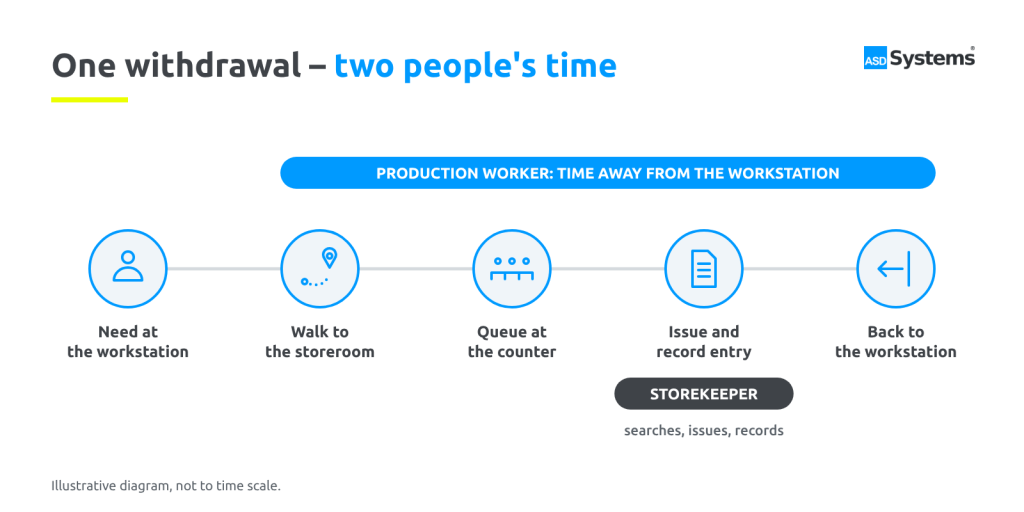
In a traditional system, every issue requires staff involvement. A warehouse or tool crib attendant must locate the product, hand it over and record the withdrawal. In some cases, they must also verify the employee’s authorisation or find the key to the correct PPE locker.
When withdrawals are frequent, these activities are repeated throughout the shift. Warehouse staff spend their time handling individual issues instead of replenishing stock, monitoring inventory or working with the procurement team.
A staffed tool crib window should therefore be viewed not only as a place where products are handed out, but also as a process that involves an employee every time an item is collected.
2. Production employee time: walking, queuing and waiting
There is also a cost when a production employee has to leave their workstation.
The walk to the warehouse, time spent in a queue, the issue itself and the return to the workstation all take time that may not be recorded as downtime. This can be particularly visible at the beginning of a shift, during breaks or whenever several employees need the same type of equipment at once.
Production downtime is not always caused by machine failure. The time required to obtain basic materials also affects workflow and productivity.
3. Excess consumption and “just in case” withdrawals
If issues are not recorded accurately, it becomes more difficult to determine who collected a product, when it was collected and how many units were taken.
An employee may take more than they need to avoid another trip to the warehouse. Small tools and consumables may be stored in different places, lost or used without being assigned to a specific department or workstation.
This makes inventory control more difficult and prevents the company from establishing actual consumption accurately.
4. Capital tied up in excess inventory
A lack of reliable consumption data also makes it difficult to determine how much stock the warehouse actually needs.
Inventory may grow because the company wants to protect itself against shortages. At the same time, items may be duplicated, purchased too early or remain unused for long periods.
An analysis of safety stock and tied-up capital should therefore consider not only the value of purchased products, but also how they are dispensed and controlled.
5. Warehouse space, utilities and maintenance
The cost of traditional warehouse space, lighting, heating, cleaning and repairs can represent a significant expense. Industrial vending machines installed on the shop floor, in a changing room or in a corridor can reduce the need to maintain a separate issue store.
6. No access outside warehouse opening hours
A traditional warehouse or tool crib operates during defined opening hours. The problem arises when production continues outside those hours.
A night shift, weekend or public holiday may mean limited access to gloves, tools or consumables. As a result, an employee may be left without essential equipment, or the company may need additional organisational arrangements to provide it.
If a product cannot be collected when it is needed, the resulting access problem can affect workflow and process continuity.
7. Paper records and audit risk
A notebook, issue card or paper form may be simple to use, but maintaining these records becomes time-consuming and prone to error when the number of transactions increases.
It is also more difficult to reconstruct the issue history of a specific product quickly. This applies to workwear, personal protective equipment and tools.
During an inspection or audit, it may be important not only to confirm that products are available, but also to show when and to whom they were issued. Read more about PPE issue records in our article on PPE vending machines, HSE and OSHA inspections, and ISO 45001.
8. Missing data for procurement and budgeting
The final item is also one of the most difficult to notice.
If a company does not have complete consumption data, purchasing decisions may be based on estimates, employee experience or information provided by individual departments.
It then becomes more difficult to determine actual material requirements, compare consumption between departments and shifts, or prepare an accurate budget. It is also harder to explain why demand for a particular product has increased.
A lack of data is therefore a cost in itself because it limits the company’s ability to make decisions based on actual consumption.
Checklist: calculate the cost in your facility
You do not need a complex financial model to begin. Start by collecting the basic data.
Check:
If there is no readily available answer to most of these questions, that is already important information. It suggests that some of the costs of the current system may not appear in standard reports.
A new role for warehouse staff
Automating product dispensing does not mean eliminating the role of the warehouse or tool crib attendant. It primarily changes how their time is used.
Instead of focusing on handing out individual products and maintaining manual records, the employee can concentrate on replenishment, inventory control, consumption analysis and cooperation with the procurement team.
In this model, withdrawal data can be available in the IDS application and consumption reports. This allows the company to move from recording every transaction manually to managing the process with actual consumption data.
FAQ: frequently asked questions
Free consumption audit: calculate the real cost in your facility
The checklist shows where to look for the hidden costs of traditional product dispensing. The next step may be an analysis based on actual data from the facility.
A free usage audit can examine how products are dispensed and consumed, how inventory is organised and where automation could bring greater control to the process.
Only then is it useful to discuss a specific solution, including an industrial vending machine configuration tailored to the products, number of users and organisation of work.

Contact us and ask about
a free consumption audit
Next steps
If you would like to move from analysing the cost of your current system to comparing available solutions, the following articles may be useful:
- Benefits of industrial vending machines beyond the invoice
- Industrial vending machines vs a traditional warehouse: what changes in consumption control?
- How to control warehouse inventory
- Safety stock: what is it and how does it work?
Sign up for our newsletter!
Sign up and be the first to hear about new features, updates, and proven ways to save in warehouse management.