

How ASD Systems Vending Automats Help Reduce PPE Consumption in Manufacturing Facilities?
Did you know that companies using PPE vending machines report cost reductions of 30–50%? This isn’t a myth – it’s the result of implementing strict, digital control over personal protective equipment distribution and eliminating uncontrolled withdrawals.
In the traditional PPE management model, workers often take more than they need, products disappear “just in case” or end up at home, and companies have no tools to control these processes. ASD Systems vending machines are a solution that completely changes these rules of the game.
Below, we present eight key mechanisms through which vending machines help drastically reduce PPE consumption and generate measurable savings.
1. Implementing Withdrawal Limits – Up to 50% Consumption Reduction
This is the most effective mechanism for limiting consumption.
The IDS system (management software for ASD Systems vending machines) enables digital enforcement of withdrawal limits. The HSE manager or supervisor sets how much of a given item – for example, pairs of gloves, safety glasses, or ear plugs – a given employee can withdraw within a specific time period (per shift, week, or month).
How does it work in practice?
If an employee exceeds their limit, the vending machine automatically blocks the ability to withdraw another product. There’s no room for “forgetting” or error – the system enforces established rules consistently.
The result?
Employees become more responsible and aware of the value of the products they withdraw. They know they cannot take them without limits, which immediately reduces waste. Companies report consumption reductions of up to 50% through the mere introduction of limits.
2. Personalized Product Access
In a traditional warehouse, anyone can take anything. ASD Systems vending machines change this.
The system allows individual product access to be granted based on job position. A CNC operator has access to work gloves and safety glasses, but not to painter’s coveralls. A welder has access to welding shields, but not to laboratory goggles.
How does it work?
Each employee can only withdraw products that have been assigned to them with a predetermined limit. This means:
- Individualized access depending on position
- Elimination of unnecessary product withdrawals
- Responsible use of company resources
The result?
Elimination of situations where an employee “takes something just in case” or withdraws products they don’t need at all. The rate of property misappropriation quickly decreases.
3. Employee Identification – Eliminating Unauthorized Withdrawals
Traditional warehouses allow informal product withdrawals. Vending machines completely eliminate this.
Every withdrawal requires logging in – most commonly with an RFID access card or PIN code. This prevents:
- Taking products “for a colleague”
- Access by unauthorized persons
- Anonymous withdrawals without records
The result?
Every item is assigned to a specific employee, department, and cost center. This immediately limits abuse and theft. The mere awareness that “someone sees what I’m taking” significantly influences more responsible behavior.
4. Full Records and Real-Time Monitoring
The IDS system collects data in real-time, giving management a complete picture of consumption.
What can you monitor?
- Who withdrew a product
- When they withdrew it
- How many units they withdrew
- From which vending machine
- To which cost center to assign the expense
How does this help reduce consumption?
Generating detailed consumption reports broken down by employee, department, job position, and cost center enables identification of inefficient areas.
Example:
If Department A consumes significantly more gloves than similar Department B, you can investigate the cause. It might be:
- Inefficient work processes
- Improper PPE selection (gloves of too low quality, wear out quickly)
- Abuse (employees taking extras)
Thanks to the data, you can implement corrective actions and reduce waste.
5. Precise Dispensing – Single-Item Distribution
Vending machines eliminate the need to dispense entire packages when only one item is needed.
How does it work?
Drum or spiral vending machines are configured to dispense a single item:
- One pair of safety glasses
- One high-visibility vest
- One pair of gloves
The result?
This prevents:
- Wasting remaining, unnecessary items from an opened package
- Employees from taking larger quantities of products “just in case”
6. Loan System – Intelligent Tool Crib
Not all PPE products need to be “consumed.” Some can be borrowed and returned.
The intelligent tool crib function in the IDS system means that employees don’t so much take items for ownership as use them to perform specific work and then return them to storage.
How does it work?
- Employee borrows a torque wrench, performs work, returns the tool
- As long as used but not yet worn-out tools are available in storage, employees cannot withdraw new equipment
- The system monitors the wear condition of individual products
- The business owner sees return times and user names
The result?
Maximum product utilization, elimination of “everyone has their own hammer in their locker” situations, drastic reduction in new tool purchases.
7. Advanced Reporting and Automatic Notifications
The IDS system isn’t just a vending machine – it’s a management center for the entire PPE operation.
What can you gain?
- Automatic demand notifications
- Easy generation of orders and reports
- Insight into material consumption by each user
- Automatic issuance of worn products to the manager (for disposal/replacement)
- Breakdowns by cost centers
How does this help?
You can order only those products that are running low. Accumulating huge “just in case” stocks isn’t necessary – this is an important step toward reducing overall warehouse space in the company and freeing up capital frozen in inventory.
8. Eliminating Excessive Warehousing
Traditional approach: “Let’s order 10,000 pairs of gloves just to have them.”
Problem?
- Capital frozen in inventory
- Products expire
- Occupy warehouse space
- Risk of theft and losses
Solution with ASD Systems vending machines:
The IDS system shows exact consumption in real-time and predicts demand. This allows you to order products “just in time” – exactly when they’re needed, in exactly the quantity needed.
The result?
- Smaller warehouse footprint
- Smaller inventory
- Less frozen capital
Psychological Mechanisms – Awareness of Control
We cannot overlook one of the strongest mechanisms for reducing consumption: the psychological effect.
The mere awareness among employees that their withdrawals are monitored and assigned to their name significantly influences more responsible use of company resources.
This isn’t “spying” – it’s transparency and accountability.
Employees know:
- What they withdrew
- How much they still have in their limit
- That their actions are visible
The result?
The era of “I’ll take three pairs of gloves because they might come in handy” or “I’ll take batteries home” ends. Employees begin to treat company resources like their own – with respect and responsibility.
Concrete Financial Benefits – The Numbers Speak for Themselves
Companies using ASD Systems vending machines report:
✅ 30-50% reduction in consumption – main benefit thanks to limits and control
✅ Optimization of inventory and purchasing costs – you order only what’s needed
✅ Savings of up to 50% of funds spent on PPE procurement
✅ Elimination of waste and improper product use
✅ Reduction in warehouse space – less inventory = less space
✅ Freeing up capital frozen in excess inventory
Example:
A company employing 500 workers spending 1,000,000 PLN annually on PPE can save 300,000–500,000 PLN annually after implementing ASD Systems vending machines.
This isn’t a cost – it’s an investment that pays back.
Summary: 8 Mechanisms That Change the Game
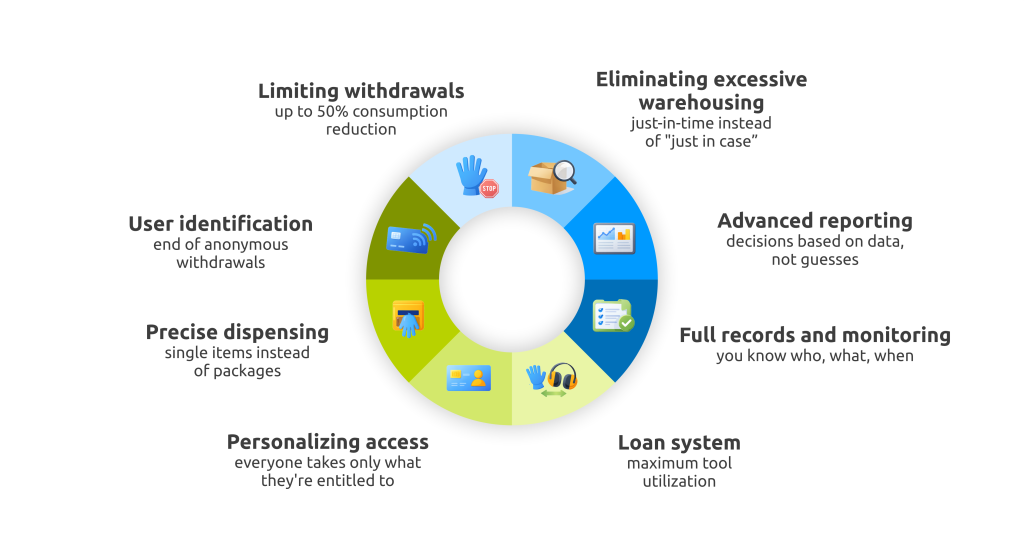
ASD Systems vending machines help reduce PPE consumption through:
The final result?
✅ 30–50% savings
✅ Full control
✅ Responsible employees
✅ Peace of mind for the HSE manager
Related articles
- Did you know that with IDS you have everything under control?
- Automation and control of the process of warehousing and issuing equipment
- What is warehouse management?
Sign up for our newsletter!
Sign up and be the first to hear about new features, updates, and proven ways to save in warehouse management.
