Industrial vending machines for procurement management – 7 benefits
In a manufacturing facility, the procurement team often learns that an item needs to be ordered only when someone on the shop floor reports that gloves, a tool, a consumable or another essential product has run out. In this situation, purchasing plans rely on requests, estimates and data scattered across several sources.
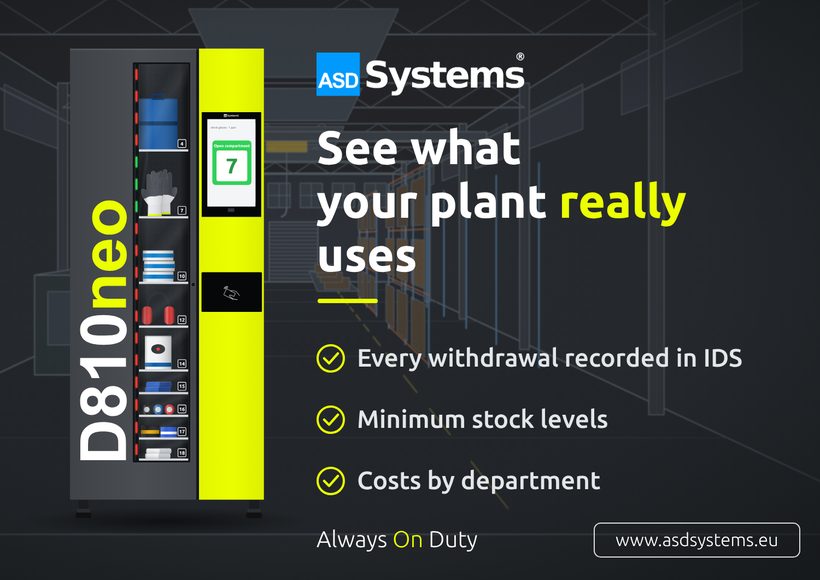
An automated dispensing system brings order to this process. In practice, it consists of more than an industrial vending machine. The solution has two components: a vending machine that controls the physical dispensing of products and the IDS application, which collects and analyses withdrawal data and provides reports to designated users.
For procurement teams, this means access to actual consumption data and a more reliable basis for order planning, product range control and budgeting.
The main benefit is straightforward: an industrial vending machine connected to IDS turns MRO and PPE procurement from a process based on estimates into one supported by actual consumption data. This information can improve demand planning, reduce emergency purchases, allocate costs to departments and provide a complete withdrawal history.
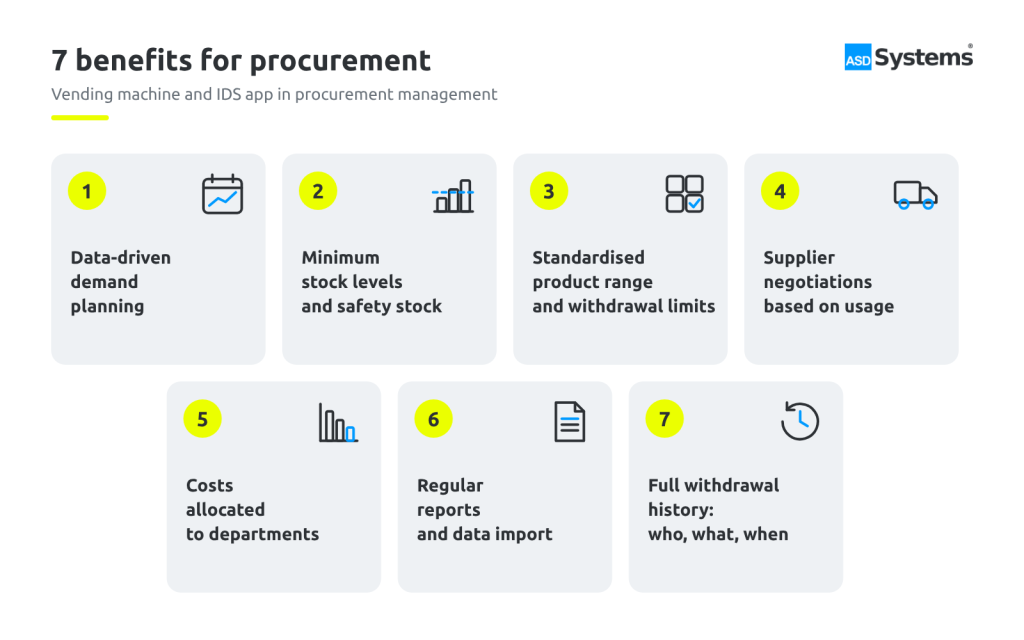
Demand planning based on data, not guesswork
One of the fundamental challenges in procurement for a manufacturing company is determining how much of each product will actually be needed in the next period.
If consumption information comes mainly from phone calls, emails, spreadsheets or manually prepared summaries, the procurement team may not have a complete view of demand. It can then be difficult to distinguish genuine material requirements from a temporary increase in withdrawals or unnecessary stock.
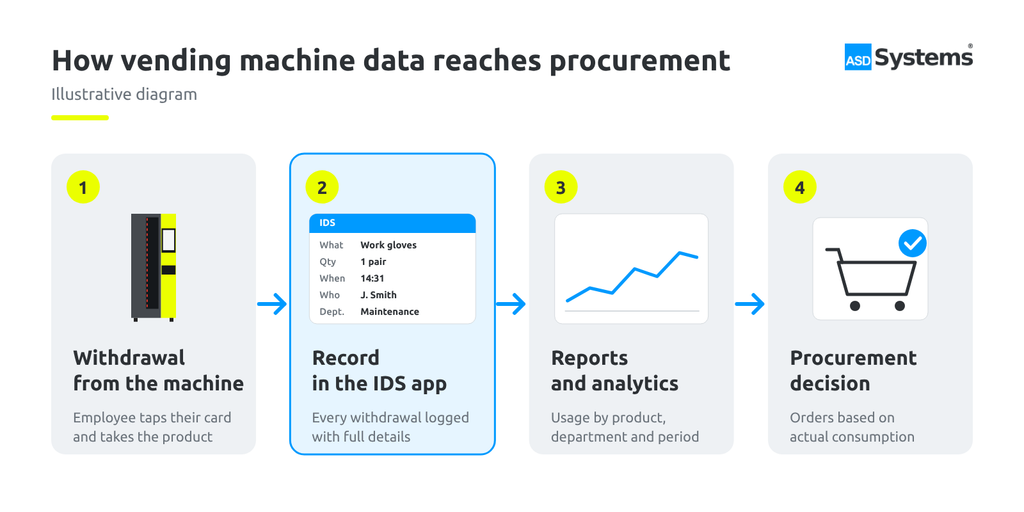
The vending machine records withdrawals, while IDS makes the collected data available for analysis. Consumption can be reviewed by product, employee, department or cost centre.
This allows purchasing decisions to be based on actual consumption history rather than declarations alone. Scheduled reports are also useful. IDS can automatically send consumption reports to designated users, eliminating the need to prepare the same information manually each time.
Read more about this feature in our article on automatically sending consumption reports by email.
Fewer emergency purchases and less firefighting
When a product required at a workstation is unavailable, an urgent order may be necessary. For the procurement team, this can mean disrupting the planned schedule, additional communication with the supplier and less time to compare the available options properly.
Minimum stock thresholds and safety stock can be used to identify in advance when the quantity of a product is approaching a defined level.
The procurement team receives an earlier warning instead of reacting only after the product has run out completely.
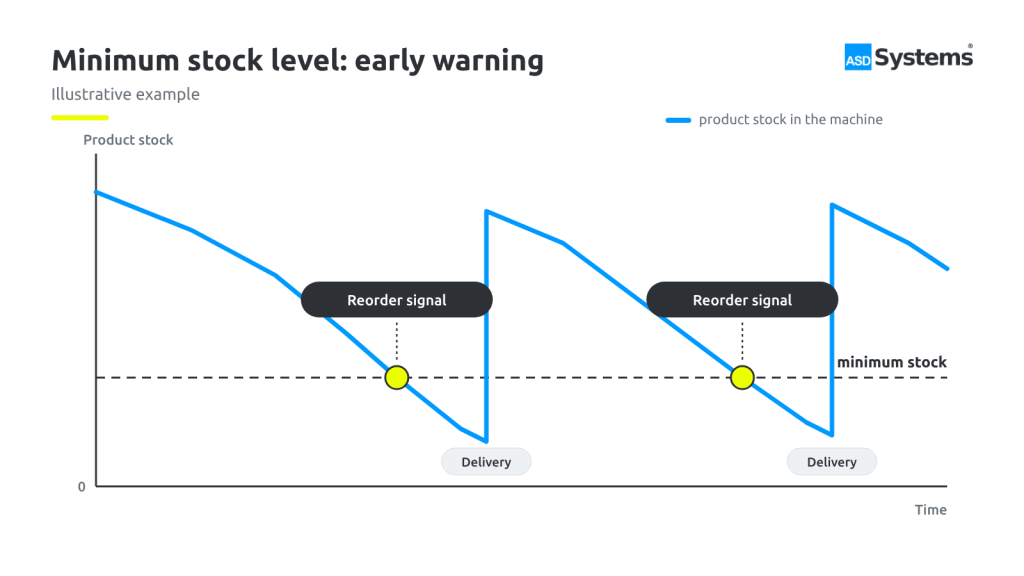
This does not mean that every order is placed automatically. The final decision remains with the people responsible for procurement. The system provides the data they need to make that decision at the right time.
For more on this approach, see Safety stock: what is it and how does it work?
Fewer SKUs through product standardisation
Procurement becomes more complex when different departments order multiple variants of products that serve the same purpose.
This applies to gloves, personal protective equipment, tools and consumables. In the case of tools, it also has a direct impact on tool inventory management.
An industrial vending machine can be configured with a defined product catalogue based on the assortment approved by the company. This helps standardise the products available to employees and reduces situations in which every department develops its own approach to supplies.
Withdrawal limits provide an additional control mechanism. They can be assigned to individual employees or entire departments and used not only to control costs, but also to maintain an agreed product standard.
Learn more about withdrawal limits for employees and departments.
Supplier negotiations based on actual consumption
Negotiating supply terms requires reliable information about what the company actually needs. If consumption data is incomplete, the order volume may be based largely on estimates.
The vending machine’s withdrawal history gives the procurement team an additional source of information. It shows how much of a product was actually collected over a defined period, providing a stronger basis for discussions with the supplier.
This supports both current purchasing decisions and the planning of delivery frequency.
Actual consumption data can also help reduce excess stock ordered “just in case”. This matters both for storage costs and for the space occupied by products that are not currently needed.
Cost allocation by department and better budgeting
Knowing how much of a product the company used may not be enough. Procurement and controlling teams often need an answer to a more detailed question: which department or area generated the consumption?
IDS supports cost centres and allows products to be assigned to relevant areas of the organisation. The system can also use a price assigned to each product, making it possible to calculate the value of the items consumed.
The assigned price is used to determine the consumption cost of a specific item held in the vending machine.
This data allows procurement teams to look beyond the total number of units ordered and see how products are used by individual departments. It also provides an additional basis for planning future budgets.
Read more about assigning prices to products in IDS.
Less administrative work for procurement teams
A significant share of the procurement team’s time may be spent not on supplier negotiations, but on preparing the information required to make decisions.
If consumption data is spread across several spreadsheets, emails, paper records or department-level summaries, collecting it requires additional work.
Automated dispensing reduces many of these manual tasks. Withdrawals are recorded by the vending machine and made available in IDS, while recurring reports can be generated according to the company’s requirements.
Depending on the configuration, data can also be imported automatically from company systems, reducing the need to re-enter the same information manually.
For more information, see Did you know you can automate data imports?
A complete audit trail: who collected what and when?
For procurement teams, it is important to know not only how much product was dispensed, but also who collected it, when the withdrawal took place and which item was involved.
IDS records user activity and creates a history of operations related to product dispensing. This means the data shown in reports can be linked to specific events.
This is useful during internal reviews, when analysing unusual consumption or when preparing evidence to support a planned budget.
From a procurement perspective, an audit trail primarily means greater transparency. Instead of searching for information in several places, the team can work with data collected in one system.
More details are available in Did you know that with IDS you have everything under control?
FAQ: frequently asked questions
Start with a usage audit
An industrial vending machine does not replace the procurement team. It provides the data that is often missing from a traditional supply model.
Actual withdrawals, consumption history, minimum stock thresholds, limits, cost centres and reports make it possible to treat MRO and PPE procurement as a measurable process that can be analysed and improved.
If you would like to see how this solution could work in your facility, begin with an analysis of your current supply process.
Contact us and ask about a free usage audit
Related articles
- IDS application for vending machine management
- Safety stock: what is it and how does it work?
- Automatic consumption reports by email
- Automated data imports
- Withdrawal limits for employees and departments
- User activity records in IDS
Sign up for our newsletter!
Sign up and be the first to hear about new features, updates, and proven ways to save in warehouse management.