


PPE vending machines, HSE and OSHA inspections, and ISO 45001 — Compliance and PPE issue records in the United Kingdom and the United States
When a safety inspector or an ISO 45001 auditor enters a facility, the first question is rarely, “Do you have a PPE vending machine?” The real question is whether the organization can show that workers have access to suitable personal protective equipment, selected for the hazards of the job, and that the process is controlled in practice.
That evidence looks different in Great Britain and the United States. UK law focuses on risk assessment, suitable provision, maintenance, storage, instruction, training and correct use. In the United States, federal OSHA requires a workplace hazard assessment, written certification of that assessment for the relevant general-industry PPE provisions, proper selection and fit, training and the use of safe, serviceable equipment. A named issue record for every pair of gloves or earplugs is not a universal statutory requirement in either market. Even so, a reliable distribution history can be valuable supporting evidence during an inspection, an ISO 45001 audit or an internal investigation.
This guide is written for EHS and HSE managers, ISO 45001 representatives, production managers, procurement teams and PPE distributors. It explains the employer’s duties in the UK and the US, what inspectors and auditors may examine, and how a PPE vending machine connected to the IDS management system can support a controlled, evidence-based process.
Important: This article provides general compliance guidance, not legal advice. Requirements vary by jurisdiction, industry, hazard and PPE category. In the US, OSHA-approved State Plans may impose different or additional requirements. Always confirm the current rules with your competent safety professional or legal adviser.
Employer duties for PPE: what needs to be controlled and documented?
United Kingdom: risk assessment, suitable provision and correct use
In Great Britain, the Personal Protective Equipment at Work Regulations 1992, as amended in 2022, require employers to provide suitable PPE where risks cannot be adequately controlled by other means. The 2022 amendment extended relevant duties to limb (b) workers as well as employees.
- Provide required PPE free of charge when the risk assessment shows that it is necessary.
- Assess PPE before use and select equipment that is suitable for the hazard, the task and the individual user.
- Make sure different items of PPE are compatible when they must be worn together.
- Maintain, replace and store PPE so that it remains effective and hygienic.
- Provide sufficient information, instruction and training, and make sure workers use PPE correctly.
- Ensure PPE is readily available; simply keeping it somewhere on the premises is not enough.
UK legislation does not create a single universal “PPE issue card” requirement for every item. The records an employer needs will depend on the risk assessment, internal controls and any more specific rules that apply to the equipment or activity. Distribution records can nevertheless help demonstrate availability, replacement and consistent application of the company’s PPE arrangements.
United States: OSHA hazard assessment, selection, training and payment
For US general industry, the core federal requirements are set out in 29 CFR 1910.132. Construction, maritime and other sectors have additional standards, and specific PPE types – such as respirators or fall protection – are subject to their own detailed requirements.
- Assess the workplace to identify hazards that require PPE.
- Select PPE that protects against the identified hazards and properly fits each affected employee.
- Verify the hazard assessment through a written certification identifying the workplace, the person certifying it and the date.
- Train affected employees on when PPE is required, what is required, how to put it on and remove it, its limitations, and its care, maintenance, useful life and disposal.
- Require employees to demonstrate understanding and retrain them when workplace conditions, PPE types or employee knowledge change.
- Do not allow defective or damaged PPE to be used.
- Provide and pay for required PPE, subject to the exceptions stated in 29 CFR 1910.132(h).
Federal OSHA does not generally require an individual transaction log for every disposable PPE item. It does, however, require specific records in parts of the PPE framework – including the written hazard assessment certification – and additional documentation may be required by equipment-specific standards. State Plan requirements can differ or go further.
The evidence chain: more than a transaction log
The strongest PPE documentation links the hazard to the decision, the decision to the product, and the product to actual availability and use. A practical evidence chain may include:
- Risk and hazard assessments – the hazards, tasks and groups of workers covered.
- PPE selection matrix – which product or protection level is assigned to each role or task, and why.
- Product conformity evidence – the marking, approval, instructions and technical evidence appropriate to the market and PPE category.
- Training and competence records – who was trained, on what, when, and when retraining is due.
- Issue, return and replacement history – supporting evidence that PPE was available to identified users when needed.
- Inspection and maintenance records – particularly for reusable, life-critical or regulated equipment.
- Exception records – stockouts, damaged items, emergency replacements, overrides and corrective action.
Evidence limit: A vending transaction shows that an item was dispensed to an identified user. It does not, by itself, prove that the PPE was correctly selected, properly fitted or actually worn. Transaction data must be read together with risk assessments, training, supervision, workplace observations and equipment-specific records.
PPE product conformity: UK and US rules are not interchangeable
Great Britain and Northern Ireland
For Great Britain, Regulation 2016/425 as assimilated into UK law and the Personal Protective Equipment (Enforcement) Regulations 2018 govern PPE placed on the market. Since 1 October 2024, businesses may use either UKCA or CE marking for PPE placed on the market in Great Britain, provided the applicable conformity requirements are met.
For an audit-ready product file, keep the relevant marking information, declaration of conformity, user instructions, product identification and evidence appropriate to the category. Northern Ireland follows a different route under the Windsor Framework: CE marking is required, with CE and UKNI used in the relevant cases when a UK body carries out mandatory third-party assessment.
United States
The United States does not use one CE- or UKCA-style conformity mark across all PPE. OSHA’s PPE standards are organized by industry and equipment type, and many categories must meet or be equivalent to the relevant ANSI or other consensus standards incorporated into OSHA rules.
Respiratory protection is a particularly important example: where OSHA requires workplace respirators, employers must use NIOSH Approved respirators and follow the applicable respiratory protection program, medical evaluation and fit-testing requirements. For other PPE, retain the manufacturer information, test or certification evidence, model identification and instructions needed to show that the product is suitable for the recognized hazard and meets the applicable standard.
What may an HSE or OSHA inspector examine?
Great Britain: evidence that the PPE arrangements work in practice
An HSE inspector will not assess a PPE process solely by checking whether equipment is present. The focus is whether risks have been assessed and controlled and whether the PPE arrangements are suitable and effective. Depending on the workplace and hazard, the review may include:
- The risk assessment and the reason PPE remains necessary after higher-level controls have been considered.
- Whether PPE is suitable for the task, compatible with other equipment and appropriate for the wearer.
- Whether workers can obtain the PPE when they need it and whether they actually use it.
- Maintenance, storage, replacement and arrangements for reporting loss or defects.
- Information, instruction and training.
- Compliance with the applicable UK product-supply requirements.
United States: OSHA’s documented and observable requirements
For a US general-industry inspection, a compliance officer may examine both documents and workplace conditions. Typical points include:
- The written certification of the workplace hazard assessment.
- The link between identified hazards and the PPE selected for each affected employee.
- Proper fit, availability and actual use.
- Employee knowledge, training and retraining.
- The condition, maintenance and sanitation of PPE.
- Whether required PPE is employer-paid, subject to the federal exceptions.
- Compliance with equipment-specific standards, such as respiratory, eye, head, foot, hand or fall protection.
The most common documentation problem is not the complete absence of PPE. It is a broken chain of evidence: the assessment is in one system, the product specification in another, the training record elsewhere, and no one can quickly show how the controls operate together.
ISO 45001: what the management system expects
ISO 45001:2018 does not require an organization to install a vending machine. It provides a framework for an occupational health and safety management system based on hazard identification, risk assessment, operational control, legal compliance, worker participation, monitoring, auditing, management review and continual improvement.
Operational control and documented information
If an organization decides that controlled PPE distribution is part of its operational controls, it should be able to show that the process is implemented as planned. A digital issue history can support that evidence, particularly when it is connected to approved product profiles, access rules, replenishment procedures and responsibility for exceptions.
Monitoring, trends and continual improvement
Reliable distribution data can also support management review. Consumption trends may reveal a stock problem, a task that is wearing out equipment faster than expected, incorrect product selection, a training gap or a change in operating conditions. The value lies not in collecting more data, but in using it to investigate causes and improve the control.
How ASD Systems vending machines and IDS support audit evidence
Clear boundary: A vending machine does not replace the employer’s legal duties, the risk or hazard assessment, training, fit testing, supervision or competent inspection. It supports the process by recording distribution and enforcing the access rules configured by the organization.
A digital transaction trail: who, when, what and how much
Each dispensing transaction can be associated with an identified user and record the date and time, product or SKU, quantity, machine or location and, where configured, a cost center. This creates a consistent digital history without handwritten issue sheets or signatures added later.
For the record to be credible, the organization should control user identities, permissions and product master data; synchronize device time; define retention and access rights; reconcile physical stock; and document how corrections or overrides are made. The system should be described as a verifiable digital trail – not as proof that can never be changed unless that claim has been technically established.
Employee-level PPE issue records
Because IDS records each transaction, it can generate an employee-level distribution history without paper forms. For organizations that choose or are required to keep issue records, this makes it easier to retrieve current evidence during an inspection or audit. It does not remove any separate requirement for training records, respirator fit testing, maintenance logs or other equipment-specific documentation.
Access control: approved PPE for the role or task
IDS access profiles can limit the products displayed or dispensed to those approved for a worker’s role, department or task. A welder can be assigned welding gloves rather than general-purpose gloves; a worker in a designated noise area can be given access to the approved hearing protection.
The system enforces the mapping configured by the employer; it does not create that mapping. The PPE selection must still come from a competent risk or hazard assessment and be reviewed when the task, process, material or workforce changes.
Dispensing limits, replacement rules and low-stock alerts
IDS can apply dispensing limits by employee or department and can issue low-stock alerts before an item runs out. These tools help align routine consumption with expected replacement cycles and support replenishment planning.
Safety-first configuration: A cost-control limit must never prevent a worker from obtaining necessary replacement PPE when equipment is lost, damaged, contaminated, defective or no longer provides protection. Configure a documented override, supervisor approval or escalation route and test it outside normal warehouse hours.
Product records and market-specific evidence
The product master file can connect the dispensed SKU with the information the organization needs to retain: for example, UKCA or CE details and a declaration of conformity for Great Britain, or the applicable US manufacturer data, consensus-standard evidence and NIOSH approval information for respirators. This helps prevent a transaction record from becoming detached from the specification of the product actually issued.
Reports for EHS, HSE and ISO 45001 management review
IDS can generate reports by employee, department and period. Instead of manually reconstructing consumption, the organization can identify trends, compare sites or teams and investigate anomalies. A difference in use should be treated as a prompt for investigation – not automatically as evidence of misuse. The cause may be the task, product durability, fit, training, shift pattern or working environment.
From small consumables to larger protective equipment
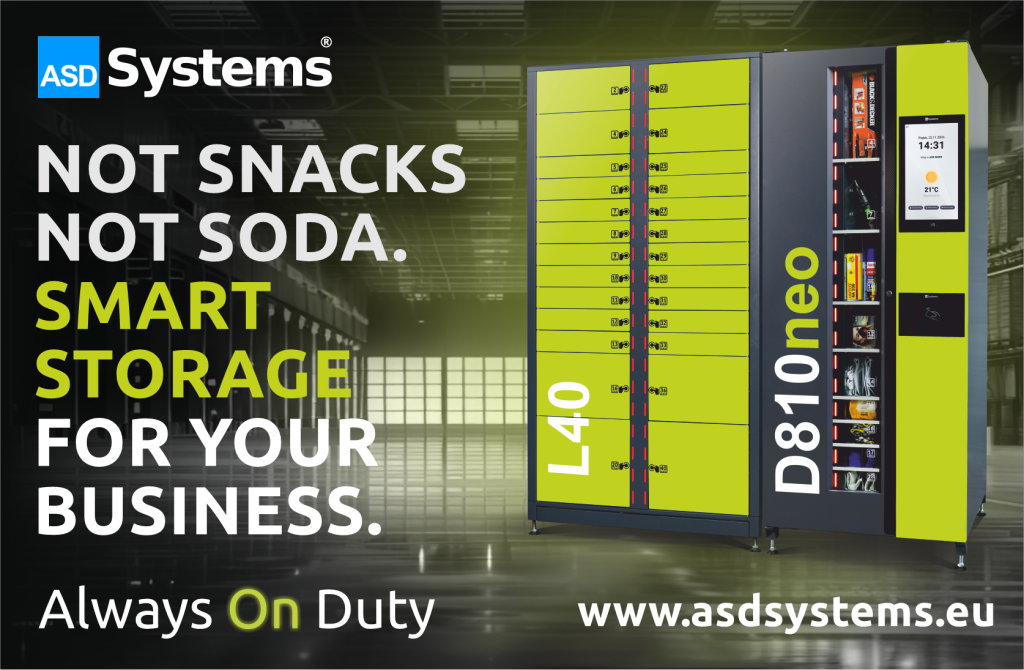
ASD Systems’ drum-based D810neo, D540neo and D1080neo models, together with the L40 vending locker, allow the same controlled process to cover small PPE consumables as well as larger items. The correct machine and compartment configuration should be selected around the product range, workforce, site layout and replenishment process.
Inspection and audit readiness checklist
Before an HSE or OSHA inspection, an ISO 45001 audit or an internal review, confirm that the following evidence is current, connected and easy to retrieve:
The objective is not to produce the largest possible file. It is to show a coherent line from hazard assessment to suitable PPE, from suitable PPE to worker access, and from access to monitoring and improvement.
Choose the right PPE vending system for your facility
A well-designed vending process can improve 24/7 access, reduce manual administration and give safety, production and procurement teams one consistent view of PPE distribution. The starting point should always be the site’s hazards, workforce and current procedures – not the machine alone.
Explore ASD Systems vending machines or book a free consultation to match the hardware and IDS configuration to your operation.
Find the Right Configuration
for Your Facility
FAQ: PPE vending, HSE/OSHA inspections and ISO 45001
Official regulatory and standards sources
- HSE: Using personal protective equipment (PPE) to control risks at work
- HSE: Extended scope of the PPE at Work Regulations
- GOV.UK: Regulation 2016/425 and the PPE (Enforcement) Regulations 2018 – Great Britain
- OSHA: 29 CFR 1910.132 – General requirements
- OSHA: Personal Protective Equipment standards
- OSHA: State Plans
- NIOSH: Identifying NIOSH Approved respirators
- ISO: ISO 45001:2018 – Occupational health and safety management systems
Related ASD Systems resources
- Industrial vending: how to choose the right solution for your business
- How to effectively control the distribution of PPE
- IDS Application
- How ASD Systems vending machines help reduce PPE consumption
Sign up for our newsletter!
Sign up and be the first to hear about new features, updates, and proven ways to save in warehouse management.
