

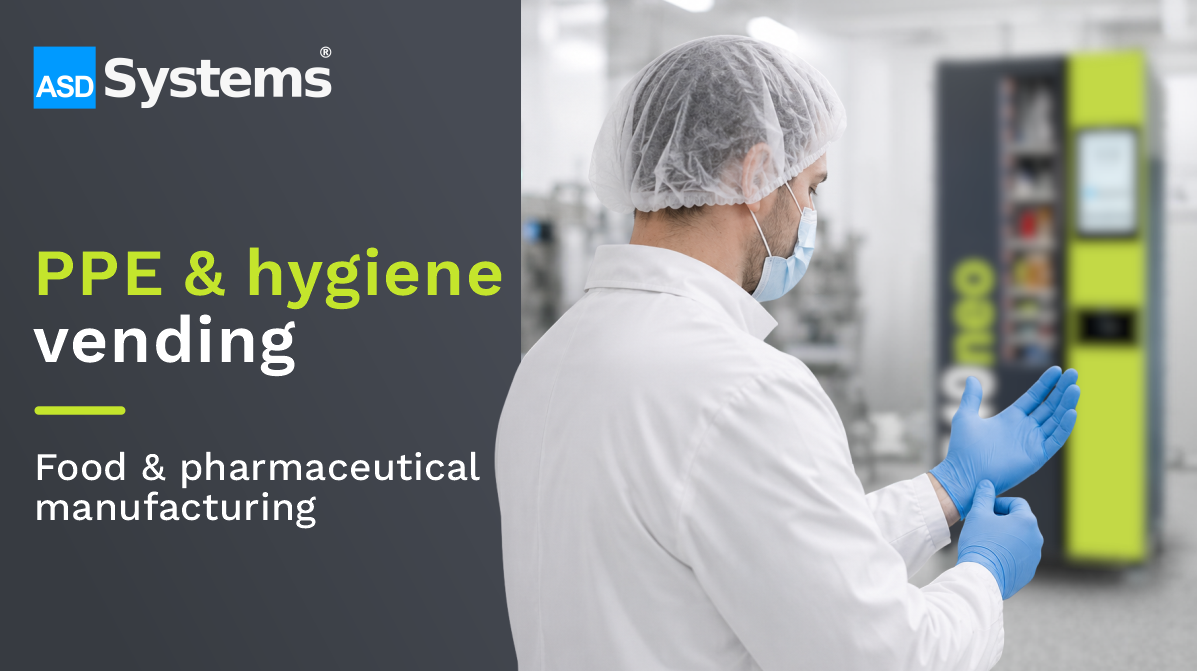
Vending machines in food and pharmaceutical manufacturing — supporting BRCGS, IFS, SQF and GMP compliance
In a food or pharmaceutical facility, the way employees obtain gloves, hairnets, protective clothing and other hygiene supplies is more than a logistics issue. It forms part of the site’s contamination-control and product-safety system.
During a BRCGS, IFS or SQF audit — or an inspection under UK or US good manufacturing practice requirements – the reviewer will look beyond written procedures. They may examine whether suitable supplies are available where they are needed, whether personnel understand and follow gowning and hygiene rules, how access is controlled, how stock is managed and what records are available when an exception or investigation occurs.
An industrial vending machine can support this process by controlling access, recording each issue transaction and providing stock data. It does not certify a facility or prove on its own that an employee wore an item correctly. Its value lies in turning an uncontrolled “take what you need” process into a managed and reviewable distribution event.
This guide explains how automated dispensing can support food-safety and pharmaceutical quality systems in the UK and the US, which standards are relevant, what records can be useful during an audit and how to specify equipment for hygiene-sensitive areas.
Terminology note: Hairnets, beard covers, shoe covers and disposable gowns are often worn primarily to protect the product rather than the wearer. For that reason, “PPE” is not always the technically correct term. This article uses protective clothing, PPE and hygiene supplies as an inclusive description.
Why dispensing hygiene supplies is part of product safety
In a controlled production area, people and the items they bring into the area can become contamination vectors. Incorrect gloves, a missing hair restraint, damaged protective clothing or garments transferred from a lower-hygiene area may create microbiological, chemical, allergen or physical contamination risks.
Food-safety and pharmaceutical quality systems therefore treat personnel hygiene and protective clothing as prerequisite controls, not optional extras. A conventional storeroom or open cabinet may provide the required products, but it does not automatically show who collected an item, which item was issued, when it was collected or whether stock was available at the point of need.
Automated dispensing helps close those gaps. Depending on the configuration, the system can:
- allow access only to approved users or employee groups;
- assign products to departments, roles or hygiene zones;
- record the user, item, quantity, date and time for each issue;
- apply quantity limits and validity periods;
- provide real-time stock information and low-stock alerts;
- support expiry-date and stock-rotation workflows;
- generate searchable reports for internal review or external audits.
These records are supporting evidence. Auditors and inspectors will still assess the site’s risk analysis, procedures, training, supervision, observed working practices, cleaning controls, corrective actions and management review.
Standards and regulatory frameworks in the UK and the US
Although the legal and certification frameworks differ, they share several practical expectations: risk-based controls, documented procedures, suitable hygiene practices, effective implementation and records that demonstrate the system is operating as intended.
UK food manufacturing: HACCP-based systems and BRCGS
UK food businesses are expected to operate a documented food-safety management system based on HACCP principles. The detailed legal framework varies across England, Wales, Scotland and Northern Ireland, so each facility should confirm the requirements that apply to its location and activities.
BRCGS Global Standard Food Safety is especially prominent in the UK and is also used internationally. The current certification standard is Issue 9 while Issue 10 is under development. BRCGS examines a site’s premises, operational systems and procedures, including personnel hygiene and the availability and use of suitable protective clothing.
Automated dispensing can support these controls by keeping approved hygiene supplies available, restricting access by role or area and producing issue and stock records. It does not replace the site’s BRCGS procedures or the auditor’s observation of actual practices.
IFS Food: documented, risk-based personal hygiene
IFS Food is a global certification standard widely used in European and international retail supply chains. IFS Food Version 8 requires risk-based personal-hygiene rules to be documented, implemented and maintained. These rules cover areas such as hair and beards, protective clothing, hand washing and disinfection.
IFS also requires the rules to be understood and applied by relevant employees, contractors and visitors. A vending system can support implementation by making the correct supplies available and creating distribution records, but training, supervision and compliance on the production floor remain essential.
US food manufacturing: FDA FSMA, CGMP and SQF
For many FDA-regulated human-food facilities in the US, 21 CFR Part 117 establishes current good manufacturing practice requirements and hazard-analysis and risk-based preventive controls under the Food Safety Modernization Act (FSMA).
The personnel requirements in 21 CFR 117.10 include maintaining personal cleanliness, wearing suitable outer garments, keeping food-handling gloves intact and sanitary, and using effective hair restraints where appropriate. The regulation focuses on preventing allergen cross-contact and contamination.
HACCP remains a central food-safety methodology in the US, but the legal route depends on the product and regulator. FDA HACCP regulations apply to sectors such as seafood and juice, while USDA-FSIS requirements apply to meat and poultry. Many other FDA-registered facilities operate under the FSMA preventive-controls framework.
SQF is also widely used by US retailers, brand owners and manufacturers as a GFSI-recognized certification scheme. Edition 9 remains the code used for current certification audits in 2026; Edition 10 has been published for transition planning, with audits expected to begin in 2027 once the implementation conditions are met.
For a US facility, dispensing records may support the personnel-hygiene and prerequisite programs within its food-safety plan or SQF system. They are not a substitute for the food-safety plan, required monitoring records or sanitation verification.
Pharmaceutical manufacturing: MHRA GMP, FDA CGMP and GxP
Pharmaceutical manufacturing operates under a stricter contamination-control and documentation regime.
In the UK, the Medicines and Healthcare products Regulatory Agency (MHRA) enforces GMP requirements for medicinal products. Manufacturers should confirm the current rules that apply in Great Britain and Northern Ireland, as well as any relevant guidance for sterile or non-sterile operations.
In the US, FDA current good manufacturing practice requirements for finished pharmaceuticals are set out in 21 CFR Parts 210 and 211. Under 21 CFR 211.28, personnel must wear clean clothing appropriate to their duties and protective apparel where necessary to protect drug products from contamination.
Within either system, an automated withdrawal log can support control of gowning supplies and stock availability. However, if the data are used as required GMP records or to make product-quality decisions, the facility must assess system validation, access controls, data integrity, retention, review and – where applicable in the US – 21 CFR Part 11. A standard vending implementation should not be described as “GxP validated” or “Part 11 compliant” unless that status has been formally established for the specific use and configuration.
| Framework | Obszar | Primary market or context | How automated dispensing can support the system |
|---|---|---|---|
| BRCGS Food Safety Issue 9 | UK and global food supply chains | Food-safety management, site standards, personnel hygiene, protective clothing and documented controls | Controlled availability of approved items, role-based access, issue records and stock reporting |
| IFS Food Version 8 | European and international food supply chains | Product and process compliance, risk-based personal hygiene, protective clothing and records | Product assignment by role or area, transaction history and evidence for internal review |
| SQF Code | US and global food supply chains | HACCP-based food-safety systems, prerequisite programs and site implementation | Availability controls, user permissions, issue data and inventory monitoring |
| UK HACCP-based food-safety management | UK food businesses | Hazard analysis, preventive controls, monitoring, corrective action and records | Supports prerequisite programs and provides supplementary distribution and stock evidence |
| FDA FSMA / 21 CFR Part 117 | Many US human-food facilities | CGMP, personnel hygiene, hazard analysis and risk-based preventive controls | Helps manage hygiene supplies and document issue transactions; does not replace required food-safety records |
| UK and US pharmaceutical GMP / GxP | Pharmaceutical manufacturing | Contamination control, personnel practices, traceability, data integrity and documented quality systems | Controlled issue of gowning supplies and operational records, subject to the facility’s validation and data-governance assessment |
Important: A vending machine supports process control and documentation. It does not certify the facility, replace its food-safety or pharmaceutical quality system, or guarantee compliance. Equipment construction and siting must be selected for the actual hygiene zone and cleaning regime.
How automated dispensing supports a controlled process
1. Role- and zone-based access
After identification by employee card, code or another approved method, the machine can display or issue only the products assigned to that user or group.
For example, an employee entering a high-care food-production area may be assigned nitrile gloves, a hairnet, beard cover, protective coat and detectable earplugs, while a packaging employee receives a different set. In a pharmaceutical facility, access profiles can reflect the site’s gowning SOP and room classification. This converts a written rule into a practical distribution control. It does not confirm that the employee put the item on correctly, changed it at the required time or followed hand-hygiene procedures. Those controls still depend on training, supervision and observation.
2. Searchable issue records and reports
Each completed transaction can record who collected an item, what was issued, the quantity and the time of issue. IDS can filter transactions and generate reports by user, employee group, department or selected period.
During an internal review or certification audit, these reports can help demonstrate that the distribution process is active and that supplies are being issued through the defined system. They may also reveal unusual consumption, repeated exceptions or gaps in availability that require investigation.
The report should be presented together with the relevant SOP, role assignments, training records, stock-control procedure and evidence that exceptions are reviewed. A transaction list alone is not proof of full compliance.
3. Traceability for investigations
Issue records provide traceability at the level of user, item and time. If a contamination concern, complaint or deviation arises, the facility can review which protective items were issued during the relevant period.
Where stock-lot or expiry information is captured and the implementation is integrated with the appropriate inventory system, this can provide additional investigation data. However, an issue record should not be represented as proof that a particular person worked on a specific production batch unless the facility has a validated process or system integration that establishes that link.
In other words, dispensing data can strengthen an investigation, but it does not automatically become a batch-manufacturing record.
4. FIFO, FEFO and expiry control
Hygiene consumables, disinfectants and some protective products may have expiry dates or defined shelf lives. IDS product records can include expiry dates and other product metadata, while the wider stock process can be configured to support FIFO — first in, first out — or, where expiry is the deciding factor, FEFO — first expired, first out.
The precise level of automation depends on the machine configuration, replenishment procedure and any ERP or WMS integration. The facility should verify:
- how lot and expiry data are entered;
- whether the machine physically enforces the intended stock sequence;
- who reviews upcoming expiries;
- what happens when an item expires or is placed on hold;
- how replenishment errors are detected and corrected.
This is stronger than making a general claim that the machine “guarantees FIFO”. The control is only effective when the data, loading process and physical stock flow are aligned.
5. Better separation between hygiene zones
Placing a machine at a defined transition point — for example, outside a gowning room or before entry into a high-care area — can reduce the movement of loose supplies between zones.
Employees collect clean, approved items at the point of entry instead of carrying them from a lower-control area. In UK food manufacturing, the site may use terms such as low-risk, low-care, high-care or high-risk. US facilities may use different sanitation or hygiene-zone terminology. The access profiles and machine location should follow the site’s own risk assessment and zoning plan.
The machine itself must not become a contamination source or obstruct personnel flow, hand washing, emergency routes or cleaning.
6. Stock availability and exception management
A documented hygiene rule fails in practice if the required item is unavailable. Real-time stock levels, minimum-stock alerts and replenishment reports help reduce this risk.
The facility should define who receives alerts, how quickly stock must be replenished, what approved alternative is available during a shortage and how a stockout is recorded and investigated. This connects the vending process with the site’s deviation and corrective-action system.
Hygienic design: choosing the right equipment for the area
Not every industrial vending machine is suitable for every production zone. A unit that performs well in a dry warehouse may not be appropriate inside a wet-cleaning area, a high-care room or a pharmaceutical cleanroom.
Selection should be based on a documented assessment of the location, contamination risks, cleaning method, chemicals, temperature, humidity, personnel flow, utilities and required ingress protection.
| Specification point | Typical dry-area configuration | Hygiene-sensitive configuration or control |
|---|---|---|
| Enclosure | Powder-coated steel may be suitable | Stainless steel or another smooth, corrosion-resistant finish may be required, subject to the site specification |
| Moisture and cleaning | Standard industrial design | Smooth, accessible surfaces and reduced dirt traps; installation details should support cleaning and inspection |
| Location | Storeroom, dry production support area or corridor | Gowning point, transition area or hygiene zone only where the site’s risk assessment and equipment specification permit it |
| Cleaning chemicals | Standard manufacturer-approved products | Compatibility with site disinfectants must be documented to avoid damage, corrosion or residue |
| Validation and qualification | Operational acceptance may be sufficient | Pharmaceutical use may require documented qualification, change control and assessment of computerized-system impact |
Do not assume that “stainless steel” automatically makes equipment suitable for washdown or cleanroom use. The complete design, seals, openings, screen, readers, ventilation, base, cable entries and cleaning procedure all matter.
Checklist: what to confirm before selecting a configuration
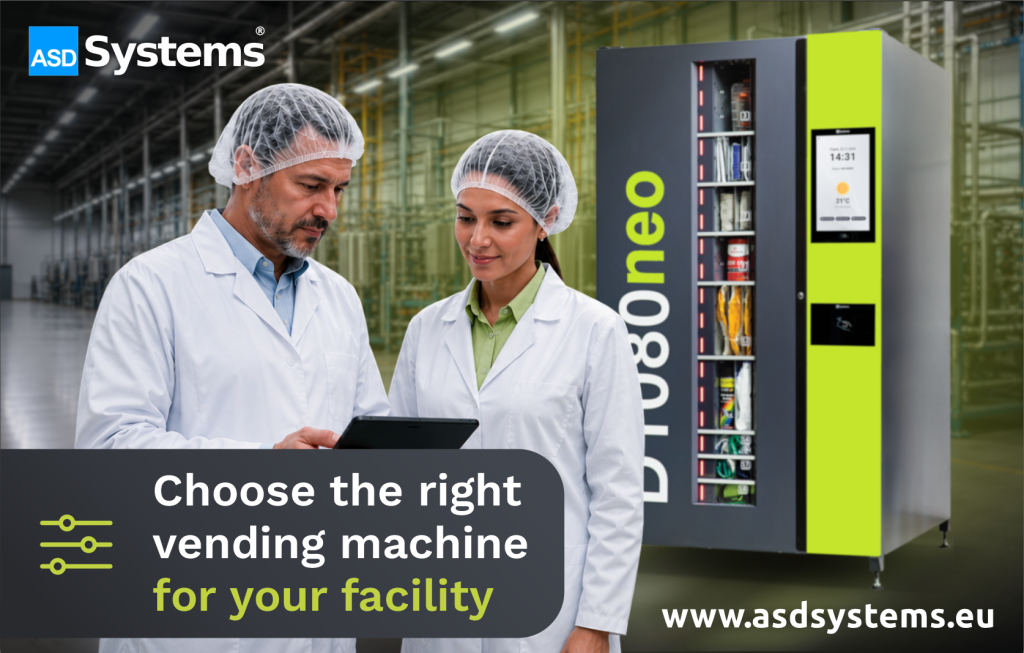
Depending on product size and capacity, the ASD Systems range may include D540neo, D810neo or D1080neo drum machines. L40 lockers can accommodate larger items, while C240 can support controlled returns. T15neo is a warehouse terminal for recording issues from a physical storeroom; it does not itself dispense products from locked compartments.
The final choice should be made with ASD Systems technical support and the facility’s food-safety, quality, engineering, EHS and IT teams.
Food manufacturing: what can be dispensed
Typical items include:
- disposable nitrile or other approved gloves;
- hairnets, caps and beard covers;
- disposable aprons and protective coats;
- sleeve protectors;
- shoe or boot covers;
- detectable earplugs and other site-approved detectable items;
- cleaning or hygiene consumables where the machine and location are suitable.
The critical question is not only what the machine contains, but who may collect each item and for which area. Access profiles can separate the requirements for raw-material handling, low-care production, high-care processing, high-risk operations and packaging.
Glove availability should never be treated as a replacement for hand washing or glove-change procedures. In the US, 21 CFR 117.10 specifically requires food-handling gloves to be maintained in an intact, clean and sanitary condition. UK and certification requirements similarly expect protective clothing and hygiene practices to be risk-based and correctly implemented.
Read more: Dispensing/vending machines in the food industry
Pharmaceutical manufacturing: higher control and documentation requirements
The same basic mechanisms apply in pharmaceutical production, but the quality and contamination-control expectations are higher.
An automated system may dispense gloves, masks, hair and beard covers, sleeve covers, overshoes, protective eyewear or other gowning components defined in the site’s SOP. Access control and availability records can support consistent distribution at a gowning point.
The implementation must nevertheless fit the pharmaceutical quality system:
- items must be approved for the relevant room and process;
- sterile and non-sterile products must be clearly segregated where required;
- storage conditions and packaging integrity must be protected;
- the machine location must not compromise the cleanroom or contamination-control strategy;
- cleaning and maintenance must follow approved procedures;
- computerized-system impact, user access, data integrity, backup, retention and change control must be assessed;
- any use of the records as GMP evidence must be defined and validated by the facility.
For many sites, the safest arrangement may be to place the machine outside the classified area and use it to control access before the formal gowning step. The correct location depends on the site’s risk assessment and cleanroom design.
Read more: Industrial dispensing machines in the pharmaceutical industry
What can the system provide for an audit or inspection?
Depending on the selected functions and data configuration, the facility may be able to provide:
The strongest audit package connects these system outputs with the site’s approved procedures, training, monitoring, deviation handling and corrective actions.
Start with a site assessment
For a compliance-sensitive food or pharmaceutical application, the best first step is an on-site assessment of:
- the products to be issued;
- user groups and access rules;
- hygiene zones and personnel flow;
- cleaning and disinfection requirements;
- capacity and replenishment frequency;
- reporting and integration needs;
- regulatory, certification and data-integrity requirements.
This assessment allows the machine, enclosure, location and IDS configuration to be matched to the actual process rather than selected as a stand-alone piece of equipment.
The best place to start is with
a free on-site assessment
FAQ: compliance, hygiene and automated dispensing
Regulatory and standard references used for this localization
- BRCGS Global Standard Food Safety Issue 9
- IFS Food Version 8
- UK food-safety management systems and HACCP principles
- Food Standards Scotland – HACCP-based systems
- FDA current good manufacturing practices for food and dietary supplements
- 21 CFR 117.10 – Personnel
- SQF Code and Edition 10 transition information
- MHRA guidance on GMP and GDP
- 21 CFR 211.28 – Personnel responsibilities
- FDA Part 11 scope and application guidance
Related ASD Systems resources
- IDS Application – user management, transactions and reporting
- How do vending machines work and when is it worth investing in them?
- Hygiene vending machines: how they work and where they can be used
Sign up for our newsletter!
Sign up and be the first to hear about new features, updates, and proven ways to save in warehouse management.
